



The Motor Vehicle Inspection System (MVIS) has been implemented and as such many vehicle owners who need to have their vehicles reregistered will now have to bring their car to a Motor Vehicle Inspection Center (MVIC). There the personnel will inspect your vehicle for its roadworthiness by testing various components which include but are not limited to your suspension, your headlights, and your exhaust system. While part of the inspection does involve emissions testing which many are familiar with by now, a new test has been added and it is the sound test. With a new variable added into the mix, we have created a quick guide to help you prepare your vehicle for the MVIC as well as to help you pass the exhaust tests.
Emissions test
One of the first few tests that will be done to your exhaust system is the emissions test. A familiar test to some as it was a previous requirement to have your vehicle renewed, the principles remain the same. The test is done in order to determine the concentration of Carbon Monoxide and Hydrocarbon emissions that your vehicle has while at idle speed.
The testing procedure will start with your vehicle being driven to the testing platform. There your car will be placed into its neutral gear with the handbrake on. From there a probe will be placed 30 cm from your tailpipe outlet and will begin to measure your emissions. It is important to note that your vehicle must be at operating temperature in order to proceed.
In the case of diesel-fed engines, what the MVIC will test for it is a little bit different. The test will instead focus on the opacity of smoke coming from the exhaust of your vehicle. The testing procedure for diesel-powered cars is the same as that of gasoline vehicles. The vehicle will be in neutral while a probe is inserted into the tailpipe. The engine will be revved two or three times prior to testing to allow for proper smoke sampling. This is done so that excess soot is removed from the exhaust system to allow for better and more accurate measurements for the vehicle.
Sound Test
As an inspection that works in conjunction with the emissions test, the sound test will measure how loud your vehicle is. It is important to note that your vehicle must not exceed 99db in order for it to pass.
For the testing procedure itself, sonometers will be placed around your vehicle specifically around your tailpipe. These will be set up 0.5 meters away from your exhaust and at a 45-degree angle. The inspector will then measure your vehicle at idle and at the 2,500 rpm mark to simulate it driving on a road.
How to prepare
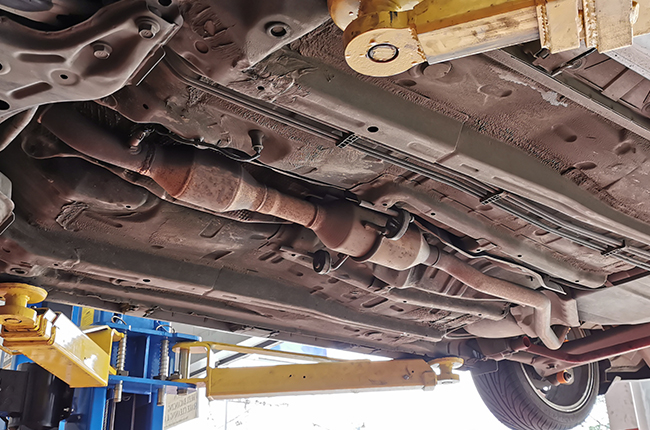
In order to prepare for these exhaust tests and to give you peace of mind, we highly suggest that you visit a trusted muffler shop or service center. There they will be able to lift your vehicle, inspect your engine, and inspect your exhaust system to see if there are any leaks or physical problems with it. There you can also get a quote to see how much repairs will cost and how much time it will take. We also suggest giving your vehicle a tune-up or having maintenance done on it so that you’ll enter the test with fresh oil and a fresh set of sparkplugs. Doing this will increase your chances of passing.
For those with modified exhaust who think they wont pass, then we highly recommend reverting back to your stock setup or consider getting a much quieter muffler in the meantime this will give you a higher "safety" margin when it comes to the testing ensuring you a higher chance of passing. You can also opt to replicate the testing parameters of the MVIC by downloading a sound measuring application on your smartphone. Through this, you will be able to get a general idea of what your sound levels are prior to actually going to an MVIC and having the test done.
Latest Features
-

5 Reasons the Audi RS e-tron GT might be the ultimate electric sedan / Featured Article
Audi’s RS e-tron GT proves the brand’s legendary sedan performance thrives in the electric era.
-
Holiday charging tips every EV driver should know / Featured Article
Before you pack your bags, make sure your EV is ready for the busy roads and cold weather.
-
Finding which JAECOO fits you? Five differences between the J7 SHS and the EJ6 you should know / Featured Article
If you’re stuck between choosing the JAECOO EJ6 and J7 SHS, here’s a handy guide to help you decide which one’s right for you.

Popular Articles
-
Electric Vehicles in the Philippines for under P1 million
Jerome Tresvalles · Aug 19, 2025
-
Top 3 Cars For Every Lifestyle—What Cars Are Right For You? | Behind a Desk
Caco Tirona · Apr 24, 2024
-
5 Tips to Maximize Fuel Efficiency
Jerome Tresvalles · Sep 09, 2024
-
Five driving habits that are draining your fuel tank
Jerome Tresvalles · Jun 24, 2025
-
Can engine braking harm your engine?
Jerome Tresvalles · Sep 11, 2025
-
Do electric cars even need maintenance?
Jerome Tresvalles · Oct 23, 2024
-
Best vehicles for an active outdoor lifestyle
Shaynah Miranda · Jul 25, 2024
-
How to drive different types of vehicle transmissions
May 23, 2024
-
5 easy ways to keep your car interior clean
Allysa Mae Zulueta · Nov 15, 2021
-
How to survive Metro Manila traffic
Earl Lee · Aug 16, 2022